
3 Tips for a Smooth European Removal Process
25 January 2025
Packing Household Goods for House Removals
2 April 2026
Cotswold Carriers boasts over 40 years of experience in removals within the UK and throughout Europe. We are members of the British Association of Removers (BAR), so you can trust that you are dealing with a reputable, professional, and financially protected company. We have used our years of experience to put together a comprehensive moving house checklist.
Our list has everything you need to plan your move, including all the admin tasks, such as who to notify of your change of address – an essential part of your moving house checklist.
Below are some ‘quick lists’, so you can see what information each section contains and jump straight to the bits you need.
Quick Lists
Before the Move
Set Up the Move
- Book a moving company or hire a van.
- Confirm the moving date in writing.
- Check parking restrictions at both properties.
- Arrange childcare.
- Arrange pet care.
- Go through your things, declutter and decide what to keep, donate, or sell.
Organise Packing
- Order packing materials or hire a packing service (a removal company like ours, Cotswold Carriers, would bring these materials with them).
- Label boxes by room and mark as “fragile” where applicable.
- Create an essentials box containing bedding, chargers, toiletries, tools, and of course, snacks and the kettle.
Property-Related Moving Tasks
- Buildings and contents insurance.
- If buying: confirm final payments, paperwork, and key collection with the solicitor.
- Notify landlord (if renting) and serve your notice.
- Book a professional clean (if needed).
- Take photos of the old property for deposit protection (if renting).
Moving House Checklist: Change of Address – Who You Need to Inform
Government & Public Services
- HMRC – tax, self-assessment.
- DVLA – driving licence & vehicle logbook (V5C).
- Local council – council tax.
- DWP (if applicable) – pensions/benefits.
- Pension providers.
- TV Licensing – update licence address.
- Electoral register – update voter registration.
Work, Education & Professional Bodies
- Employer (payroll + HR).
- Accountant/bookkeeper.
- Professional memberships.
- Education Providers.
- Childcare providers.
Banks, Finance & Insurance
- Banks & building societies.
- Credit cards.
- Loan/finance companies.
- Mortgage provider.
- Pension providers.
- Life insurance, health insurance.
Health & Medical
- GP surgery (register locally if moving area).
- Dentist.
- Optician.
- Hospital specialists/clinics.
Utilities & Household Services
At the Old Property
- Gas supplier: submit the final meter reading.
- LPG supplier (if applicable).
- Electricity supplier – final meter reading.
- Water supplier – final meter reading.
- Broadband provider – transfer or cancel.
- Landline provider.
- TV & streaming subscriptions.
- Oil provider (if applicable).
- Council waste services (bins).
At the New Property
- Compare energy tariffs (don’t assume previous supplier is cheapest).
- Register new accounts for gas/electric/water.
- Set up broadband/TV package installation.
- Test smoke alarms & carbon monoxide detectors.
Vehicles
- Insurance.
- Breakdown cover.
- Mechanic.
Postal & Online Accounts
- Royal Mail redirect service (highly recommended for 3–12 months).
- Amazon.
- eBay.
- PayPal.
- Online retailers you use regularly.
- Online banking apps.
- HMRC personal tax account.
- Subscription boxes (food, wine, books, etc.).
- Update the address on your will.
Lifestyle, Clubs & Subscriptions
- Gym membership.
- Clubs/societies.
- Magazines & newspapers.
- Charities you donate to.
- Car breakdown cover (AA/RAC/etc).
- Loyalty programmes (Boots, Waitrose, etc.).
Moving House Checklist for Your Pets
- Microchip registration (legally required to update).
- Pet insurance.
- Veterinary Practices.
- Update pet ID tags.
Miscellaneous
- Storage unit providers.
- Cleaning services.
- Gardeners/window cleaners.
- Local deliveries (milk, veg boxes, newspapers).
- Friends & family (send new address).
- Update the address on your will.
On Moving Day
- Take all meter readings; get photo evidence.
- Check every room, cupboard, loft, and shed for leftover items.
- Ensure windows/doors are secure.
- Keep keys in labelled envelopes for the new occupants.
- Check the keys for the new property.
- Take photos of the new property condition, functional for renting/insurance.
After You Move In
- Unpack essentials first.
- Connect the internet and utilities.
- Test boiler/heating.
- Locate the stopcock, fuse box, and water meter.
- Change locks for security.
Now that you have the ‘quick checklist for moving house,’ here is the ultimate checklist for moving house with detailed explanations of what to do and when to do it.

The Ultimate Checklist for Moving House
Before the Move
Preparation is key; to ensure a smooth move, plan well in advance. Giving yourself enough time will help reduce stress during the moving process and allow for some flexibility. Start by prioritising the most urgent tasks and work through your moving house checklist in order of importance.
It is also helpful to keep a folder with all the necessary documents for your move to hand.
Set Up the Move
Book a Removals Company (or Van Hire)
We know a fantastic, reliable service that can move your belongings anywhere in the UK and Europe. That’s right, it’s us! Contact Cotswold Carriers for help with your move.
Confirm the Moving Date in Writing
At Cotswold Carriers, we always confirm the moving date in writing to ensure clarity for both parties. As you can imagine, miscommunication in this area can be a nightmare. Therefore, it’s always best to check and double-check.
Check Parking Restrictions at Both Properties
The vans or lorries will need somewhere to park and load or unload, so it is a good idea to move your cars and ask neighbours to move theirs if access or parking is restricted.
Child Care
It’s often easier and safer to get on with a move without little feet running around. If you are able, we recommend adding childcare to your moving day checklist.
Pet Care
It’s a good idea to keep pets out of the way on moving day for their own safety. That said, we love animals and are always happy to meet them as long as they are friendly to our moving team and don’t get under their feet!
Declutter, Donate or Sell
Starting the decluttering process early is always a good idea, and a great way to make a little extra money to go towards your new home. There are many websites where you can sell your items online. Here are a few options.
- Nextdoor. A location-based platform where you can post items for sale or free for local collection – a great way to meet the new neighbours.
- Gumtree. A classifieds site ideal for selling second-hand furniture, vehicles, electronics and home appliances.
- Ebay. An online marketplace for new and used goods, including collectables, electronics, clothing, tools, vehicle parts and toys, with the option to auction or sell for a fixed price.
- Preloved.co.uk. An online platform useful for selling second-hand furniture, vintage items, craft supplies and musical instruments.
- Facebook Marketplace. A location-based selling platform for furniture, home goods, cars, garden equipment, baby items, tools, electronics and household items. Also offers local collection.
- Vinted. Predominantly a fashion resale platform specialising in second-hand clothing and accessories; however, you can also list electronics, unopened cosmetics and homeware.
- Depop. Great for reselling secondhand and vintage clothing and accessories.
- Vestiaire Collective. Online resale website for luxury designer items; authentication required.
- CeX (WeBuy). A high-street and online retailer buying new and used tech, DVDs, electronics & gadgets.
You could also donate clothes, shoes and accessories, furniture, electricals, homeware, toys and books to charities such as:
- British Heart Foundation (BHF).
- Barnardo’s.
- Sue Ryder.
- Oxfam.
- Salvation Army.
- Cancer Research UK.
- The Children’s Society.
- Age UK.
- British Red Cross.
- Shelter.
- RSPCA.
- Marie Curie.
Check with your local branches to see which items they are currently accepting. The following charities offer free collection for furniture and larger items.
- British Heart Foundation
- Sue Ryder
- Salvation Army
- Shelter
- Emmaus
Organise Packing
Order Packing Materials or Hire a Packing Service
A removal company like ours at Cotswold Carriers will provide packing materials during the move. But if you are going at it alone, here is a comprehensive list of packing items you may want to include on your moving house checklist.
Boxes
Small Boxes
These are best for small but heavy items like:
- Books.
- Canned goods & pantry items.
- Small electronics like tablets and cameras.
- Collectables and knick-knacks.
- Bathroom items such as toiletries, skincare, and medicines.
Medium Boxes
Your all-purpose moving box, suitable for most household items, such as:
- Kitchenware.
- Toys and games.
- Shoes.
- Small household appliances.
- Office supplies.
- Linens and towels.
- Home décor and small framed items.
Large Boxes
Ideal for light, bulky items that take up space but don’t weigh much, for example:
- Pillows, bedding, duvets.
- Curtain.
- Big plush toys.
- Winter coats (if not using wardrobe boxes).
- Lamp shades.
- Lightweight kitchen items (plasticware).
Wardrobe Boxes
Designed for clothing that is generally kept on hangers, like:
- Coats.
- Dresses.
- Suits.
- Shirts.
- Blouses.
- Long garments.
Heavy-Duty Boxes
For fragile, valuable or heavy items, such as:
- Dishes, plates, china.
- Glassware.
- Electronics like TV components and computers.
- Power tools.
- Liquids in sealed containers.
- Small appliances that require extra protection.
Document Boxes
For papers and documents, like:
- Passports.
- Certificates.
- Tax records.
- Legal files.
- Business paperwork.
- Photos.
- Notebooks and planners.
Protection
To keep fragile and valuable items safe while in transit.
- Bubble wrap.
- Packing paper.
- Foam wrap.
- Furniture blankets can be used to protect large items.
- Stretch wrap to secure furniture.
- Mattress protectors.
- Sofa covers.
- Corner protectors for TVs and mirrors.
Sealing
To make sure your boxes are secure.
- Strong packing tape.
- Fragile tape to easily discern which boxes contain delicate items.
- Tape dispenser.
- Strapping tape for extra security.
- Cable ties.
- Rubber bands to secure small items.
Labelling
So you know which items are in which boxes.
- Permanent markers.
- Colour-coded stickers for easy identification.
- Room labels for organisation.
- Inventory sheets to keep track of items.
- “Open first” stickers for essentials.
- Ziplock bags for small parts.
Tools
To help you unpack and organise.
- Scissors.
- Box cutters.
- Screwdrivers.
- Measuring tape.
- Gloves.
- Torch.
Items to help make your move as smooth as possible.
- A moving trolley for transporting boxes.
- Bungee cords for securing loads.
- Floor protection film or sheets to keep floors clean.
- Door stoppers to keep doors open whilst you move things in and out.
- Tool kit.
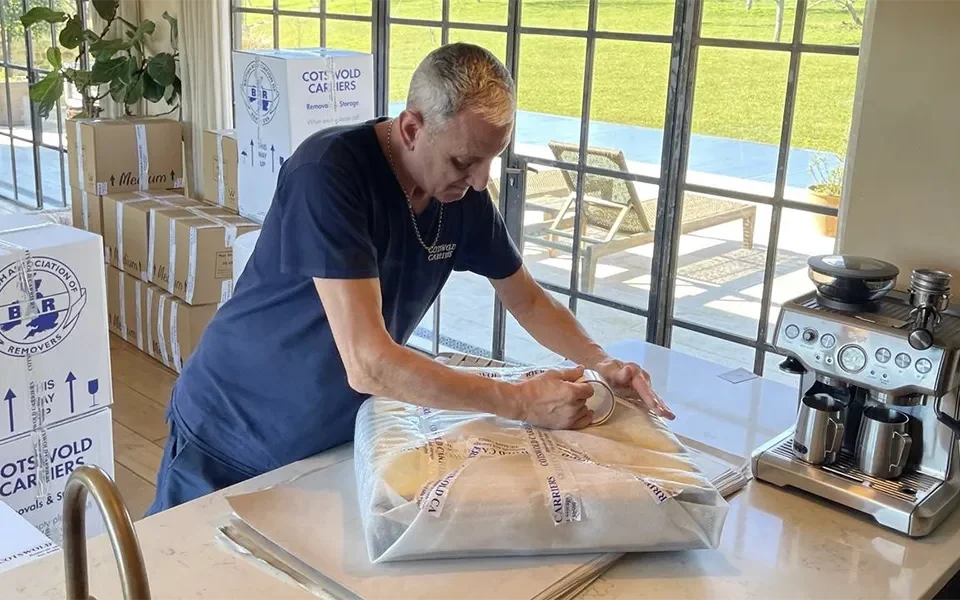
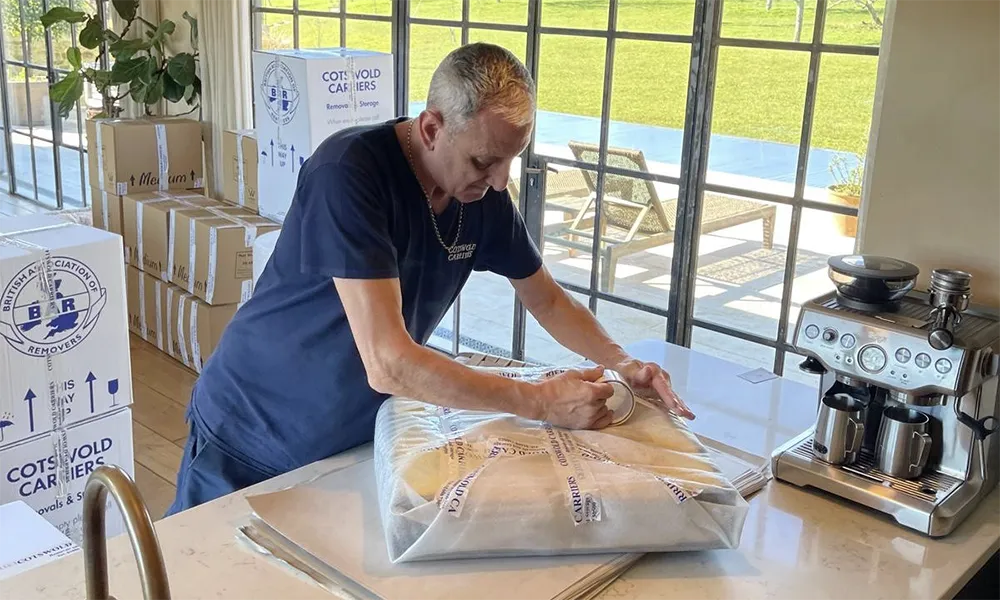
Packing for a move can be very time-consuming. To make it easier, we offer a full packing service here at Coswold Carriers, including all the packing materials you need. We provide a variety of boxes, crates, and wraps to handle your items with the highest level of care.
We can help you save time and energy with our expert packing and moving services. All you’ll need to do is contact us.
If you do decide to go it alone, here are some more tips for your moving house checklist.
[CTA]
Pack Non-Essentials Early
Label boxes by room and contents
Labelling your boxes correctly is very useful. It’s also important to label boxes containing fragile items to ensure they are handled with care by anyone helping you with your move.
Pack an essentials box
The essentials box is the final box you keep aside – the last one that goes on the truck or the one that travels with your family in the car, it’s the stuff you’ll need straight away when you arrive at your new home.
Property-related Moving Tasks
After starting the decluttering and packing process, we should consider both the old and new properties.
Buildings and Contents Insurance
Make sure to set up buildings and contents insurance for your new property to begin on moving day or earlier if you plan to start moving items in before that date. It’s also a good idea to keep your buildings and contents insurance for your old property active until the last item has been moved out and the house is no longer in your name. Doing so will ensure you are covered during the entire transition.
Confirm Final Payments, Paperwork, and Key Collection
If buying and/or selling, make sure you speak with your solicitor to double-check that all final payments are ready to go, that the paperwork is complete, and that everything is in place for you to collect the keys on moving day. Talking to them in advance helps avoid any last-minute delays and ensures transactions can be completed smoothly.
Notify Landlord (if Renting)
If you were renting the property you are vacating, make sure you contact your landlord or letting agent to let them know you’re moving out and give them any required notice in line with your tenancy agreement. Make sure to check how much notice you need to provide and put it in writing to avoid any misunderstandings.
Book a Professional Clean
Arrange for a professional cleaning service to come in before you move out so the property is left in good condition. A professional clean helps you meet the requirements of your tenancy agreement, avoids disputes over cleanliness, and increases the chances of getting your full deposit back.
Take Photos of the Old Property
Before you say goodbye to your old property, it’s a good idea to take photos of each room, including areas you have cleaned or repaired, particularly if you have been renting the property, as this shows the condition it is being left in, protects your deposit, and will help to settle any disputes that may arise later.
Moving House Checklist: Change of Address
A change of address includes informing various people and organisations. It’s easy to forget essential updates while you’re busy packing and unpacking. Our “Moving House Checklist: Change of Address” helps you keep track of who to notify. By using this checklist, you can make your move easier, avoid delays, and ensure that your mail, bills, services, and essential records stay accurate and up to date. Here’s who to notify.
Government and Official Bodies
HMRC
You need to update HMRC with your new address so all correspondence goes to the right place, to ensure your personal information stays secure, and to avoid delays or mistakes with your tax affairs or self-assessment.
DVLA
Updating your address with the DVLA is a legal requirement that ensures your driving licence and vehicle logbook (V5C) are correct, to make sure important information about your car or road tax reaches you, and you don’t risk fines.
Local Council – Council Tax
You must tell your local council when you move so they can update your council tax bill. Letting them know ensures you don’t end up paying for a property you no longer live in, miss payments for your new home or receive penalties.
DWP (if applicable) – Pensions/Benefits
If you receive benefits or pension payments, updating your address with the DWP ensures your payments continue consistently and that all official letters reach you. It helps avoid delays, errors, and overpayments.
Pension Providers
Your pension company needs your new address to send statements, updates, and important documents about your retirement savings. Keeping them up to date helps keep your long-term financial planning on track.
TV Licensing
Your TV Licence is linked to your home address, so updating it ensures you’re correctly covered in your new property, helping you avoid any risk of fines for watching live TV or using BBC iPlayer without a valid licence.
Electoral Register – Voter Registration
Updating the electoral register means you can vote in elections from your new address. It also helps improve your credit score because lenders use the register to verify your identity.
Work, Education and Professional Bodies
Employer (Payroll + HR)
Your employer needs your new address for payroll, tax records, and official documents such as payslips or contracts. Keeping them up to date also ensures your emergency contact and personal details remain accurate.
Accountant/Bookkeeper
If you have an accountant or bookkeeper, they need your updated address for tax filings, financial documents, and correspondence to ensure your accounts are accurate and compliant.
Professional Memberships
Professional organisations and bodies need your correct address to update your membership, send certificates, and maintain accurate records. Keeping this information up to date helps avoid issues with accreditation or renewals.
Education Providers
If you or your children are in education, schools and universities need your new address for emergencies, communication, and catchment-related matters, as well as to ensure they can reach you quickly when needed.
Childcare Providers
Childcare services and nurseries need your address for emergency contact, billing, and safeguarding requirements, and to keep their records accurate to ensure they can contact you.
Banks, Finance and Insurance
Banks and Building Societies
Your bank must have your correct address for fraud and identity theft prevention, identity checks, and to send important account information.
Credit Cards
Notifying your credit card provider of your move ensures that your statements, security checks, and replacement cards are sent to the correct address and helps prevent fraudulent activity.
Loan/Finance Companies
Lenders need your current address so they can contact you about repayments, agreements, or renewals. Keeping this updated also protects your credit file.
Mortgage Provider
If you have a mortgage, your lender needs your new address for official communication, statements, and future verification, and to ensure your mortgage records remain accurate.
Life and Health Insurance
Insurance companies need your new address to maintain accurate policies and ensure you’re covered correctly in your new location. Incorrect details may invalidate your policy.
Health & Medical
GP Surgeries
If you move out of your GP’s catchment area, you’ll need to register with a new surgery so you can continue receiving medical care, prescriptions, and referrals without interruption. If you are remaining with the same GP, they will need your updated address for their records.
Dentist
Updating your dentist or registering with a new practice ensures you continue to receive regular check-ups and treatment reminders. It helps maintain your dental records and emergency access.
Optician
Your optician needs your new address for appointment reminders, prescription updates, and ordering glasses or lenses. Keeping them up to date ensures your eye care continues smoothly.
Hospital Specialists and Clinics
If you’re receiving ongoing treatment, informing clinics ensures appointment letters and medical updates go to the right place. It prevents missed appointments and disruptions to your care.
Utilities & Household Services
Utility Providers and Other Essential Institutions
If you’re moving to a new location, be sure to cancel any utilities that cannot be transferred and arrange to reconnect them once you have settled in. It’s essential to notify your utility providers, financial institutions, insurance companies, and other organisations about your move.
Gas and Electricity
When moving home, you must notify your energy suppliers, such as Scottish Power, at least 48 hours in advance. When you move out, make sure to read your meters and report the readings to your supplier. Keeping a record of these can help if there are any discrepancies with your final bill. Additionally, provide your supplier with a forwarding address so the invoice reaches you.
If your property uses LPG gas, either from cylinders or a bulk tank, it is critical to inform your LPG supplier so they can update their records, arrange final readings, and settle your account. Doing so will help prevent future charges and ensure that the gas supply is safely transferred to the next residents.
Water Supply
You must inform your water provider, such as Thames Water, about your move as soon as possible. Giving them at least two weeks’ notice before you leave your current home is sufficient to ensure your final bill is accurate and prevents overpaying.
Your UK water bill includes two charges: one for water consumption and the other for sewerage and wastewater treatment. You’ll also need to contact the water and sewerage company at your new address to set up a new account.
TV Licence and Streaming Subscriptions
When moving to a new home, you’ll need to contact your cable provider, like Sky, to update your TV licence address. It’s best to do this at least three months before your move. If you are relocating outside the UK and you won’t need your licence before it expires, you may be eligible for a refund. In this case, you can submit your refund request online. Alternatively, you can terminate your licence without a refund.
Internet
You’ll need to decide whether to stay with your current broadband provider and consider various factors, including the length of your current contract. Be sure to check how long your broadband contract lasts and how much time you have remaining, as some providers impose penalties for early cancellation.
If you’re not under contract, you can cancel at any time. However, most providers require a 30-day notice before cancellation, so it’s best to call them as soon as you know your move-out date.
Council Waste Services (Bins)
You should inform your local council’s waste and recycling service when you move so they know when to stop collections at your old address and start them at your new one. Notifying them ensures you have the correct bins, collection schedules, and permits, helping you avoid missed collections or unnecessary charges.
Oil Provider (if applicable)
If your home uses heating oil, you need to inform your oil supplier when you move so they can close or transfer your account and update delivery records. Doing so helps avoid being charged for fuel delivered after you leave and ensures the new occupants can set up their own account without confusion.
At the New Property
Once you’re in your new property, it’s essential to get all of your utilities and services up and running as soon as possible. It’s a good idea to compare energy tariffs rather than continuing with your previous supplier without shopping around, as they may no longer be the best value option. Register your new energy and water accounts so billing starts promptly, and arrange the installation or activation of your broadband and any TV packages to avoid connection delays.
Finally, test all the smoke alarms and carbon monoxide detectors straight away to make sure they’re working correctly and keeping you and your new home safe from day one.
Vehicles
It is essential to update your car insurance as soon as you move because your address affects your policy and premium. Incorrect information can void your insurance and leave you uninsured. Also, make sure to inform your breakdown cover provider (such as the AA, RAC, or Green Flag) whenever you change your address.
Updating your address is essential to keep your policy details current and ensure you remain fully covered at your new location.
Your address can influence factors such as response times, eligibility for specific services, and renewal pricing, which may vary depending on the private parking and your geographical location.
Keeping your address up to date helps avoid any issues when you need roadside assistance.
It’s also a good idea to notify your mechanic about your move. If you plan to continue using the same mechanic, they can inform you about upcoming services, like when your MOT is due. If you are moving further away, you will need to find a new mechanic in your area.
Postal & Online Accounts
Consider adding the following to your moving house checklist. Letting these services know your new address will help ensure your packages are delivered to the correct address.
- Royal Mail redirect service.
- Amazon
- EBay
- PayPal
- Regularly used online retailers
- Subscription boxes (food, wine, books, etc.)
Lifestyle, Clubs & Subscriptions
- Gym membership
- Clubs/societies
- Magazines and newspapers
- Charities you donate to
- Loyalty programmes
Moving House Checklist for Your Pets
Microchip Registration
If you have a pet, you are legally required to keep its microchip details up to date, including your address when you move house. Updating the microchip registration ensures that if your pet ever gets lost, the vet, rescue centre, or authorities can contact you quickly. It only takes a few minutes to update your microchip database online, and keeping these details accurate is a legal responsibility for all pet owners in the UK.
Here are the leading UK microchip databases (all DEFRA-compliant):
Here are the most common microchip databases.
- Petlog
- Identibase
- Animal Tracker
- Pet Protect
- PetScanner
- MicroChip Central
- SmartTrace
- Agria Pet Microchips
If you don’t know which database you’re registered with, you can find out using Check-a-Chip.
Where to Look Up a Pet’s Microchip to Register a Move
Find out which database your pet is registered with by using your pet’s microchip number on Check-a-Chip. This tool will inform you which database holds your pet’s record.
To find the correct database and re-register your pet, you’ll need:
- Your pet’s microchip number.
- Your details (name, new address, phone number).
- Sometimes, there is a small admin fee depending on the database.
Pet Insurance
When you move house, it’s crucial to update your pet insurance provider with your new address so your policy remains valid. Insurance companies use your location to calculate risk and determine which vets you can use, so having the wrong address on file could affect your coverage for any future claims. Keeping your details up to date ensures your pet and your claims remain fully protected.
Veterinary Practices
Your vet needs your updated address so they can contact you for appointments, vaccinations, and emergencies. If you move out of your current vet’s catchment area, you’ll need to register with a new local vet to keep your pet’s care up to date. Start by searching for reputable veterinary practices in your new area and checking reviews or recommendations. Once you’ve chosen a vet, you can register your pet online or by calling the practice, and they’ll usually contact your previous vet to transfer medical records. Getting this done early ensures your pet is fully supported in the event of illness or an emergency.
Update ID Pet Tags
When you move to a new house, it’s imperative to update your pet’s ID tag with your new address and phone number. Pet ID tags ensure that if your pet ever gets lost, they can be reunited with you quickly. In the UK, dogs are legally required to wear a tag that includes their owner’s name and address when in public, so it’s essential to keep this information up to date. Updating the tag is both inexpensive and straightforward.
We understand this is a lot of people to notify when you are moving house, but there are just a couple more we want to cover so that you can complete your move with the utmost confidence.
Miscellaneous
Storage unit providers
Cotswold Carriers offers a variety of storage solutions in our purpose-built, secure warehouses located near Chipping Norton, Oxfordshire. We can store your belongings during your transition to a new home or commercial space, while you undergo building work, or simply to free up valuable space.
You can almost relax now, and the rest of the services you need will come over time, often by talking to neighbours and finding good, trusted suppliers.
Cleaning services
When moving into a new home, it’s helpful to arrange a cleaning service to manage housework while you settle in. You can book a one-off deep clean before unpacking or set up regular weekly or fortnightly cleans. Finding a reliable local cleaner early on helps establish your routine and keeps your home organised from the start.
Gardeners/window cleaners
At your new property, you might want to consider hiring a local gardener or window cleaner to keep the outdoor spaces clean and tidy. Check local recommendations or community groups, like Nextdoor, to find trusted professionals in your area.
Local deliveries (milk, veg boxes, newspapers)
Once settled, you can explore local delivery options and support local businesses like milk rounds, veg boxes, meal kits, or newspapers. These services can save you time and keep you stocked up on essential items. Check providers in your new area and set up or transfer subscriptions for convenient deliveries.
Friends and Family
Don’t forget to share your new address with your friends and family. If you work from home, make sure to update your clients as well. You wouldn’t want those thoughtful messages and surprises to get lost in the shuffle or end up at the wrong place. Keep everyone in the loop.
Update the Address on Your Will
When you move to a new home, update your will to reflect your new address. Keep personal details correct and avoid confusion for your executors later. It’s something that can easily get forgotten if you don’t do it now.
You usually don’t need to rewrite the entire will, but you should tell your solicitor or change the document to reflect your new address. Keeping your will accurate ensures your estate is handled smoothly without complications.
On Moving Day
Take Meter Readings
On moving day, take precise meter readings for gas, electricity, and water, and photograph each one as proof. Evidence ensures you’re only billed for the utilities you actually use and helps avoid any disputes with your old or new supplier.
Check Each Room, Cupboard, Loft and Shed
Before you leave, walk through the entire property, checking the cupboards, loft, garage, and shed, to ensure nothing has been forgotten. A final inspection helps you avoid accidentally leaving behind important items or personal belongings, and it also ensures that any strays, such as cats, are not left locked in at the old property.
When you arrive at your new property, do the same thing before you begin unpacking. Walk through the entire space, and open cupboards to confirm that everything is in order and that no previous items or rubbish have been left behind. This proactive approach lets you identify issues early and report them promptly.
Ensure Windows/Doors Are Secure
Make sure all windows and doors in your old property are properly closed and locked before you hand over the keys to keep the property secure for the new occupants and help you meet your responsibilities as the outgoing owner or tenant.
Check that all windows and doors in your new home close and lock properly, ensuring your home is secure from day one and giving you peace of mind as you settle in.
Keep Keys in Labelled Envelopes for the New Occupants
Place all sets of property keys in clearly labelled envelopes and leave them in a safe, clear place for the new occupants. Labelling makes it easy for them to know which key fits which lock, ensuring a smooth handover.
Check the Keys for the New Property
As soon as you arrive, double-check that you have all the keys you need for doors, windows, garages, and outbuildings. Confirming this early helps avoid lockouts or surprises later and gives you peace of mind that you have full access and security in your new home.
Take Photos of the New Property Condition
Before moving your belongings in, take photos of each room to record the property’s condition. Especially helpful if you’re renting, as it protects your deposit, and it’s also useful for insurance purposes if you ever need to prove the home’s original condition.
After You Move In
Unpack Essentials First
When you move into your new home, start by unpacking essentials like toiletries, bedding, kitchen basics, and any items you’ll need on the first day. Focusing on these first helps you settle in quickly and makes the rest of the unpacking process far less stressful.
Connect the Internet and Utilities
Once you arrive, make sure your internet, gas, electricity, water and internet services are connected and working correctly, and that you can use all essential appliances, stay online, and live comfortably from day one in your new home.
Test Boiler and Heating
Test the boiler and heating system as soon as you move in to confirm everything is working correctly and give you time to contact the landlord, seller, or a heating engineer immediately if something isn’t functioning, rather than discovering problems later when you need hot water or heating.
Locate Stopcock, Fuse Box, and Water Meter
Take a few minutes to find the stopcock, fuse box, and water meter in your new home so you know exactly where they are in case of an emergency. Knowing how to turn off the water, reset the electrics, or check your meter can save time, prevent damage, and help you deal with unexpected issues quickly.
Change the Locks
It’s a good idea to change the locks when you move into a new property because you can’t be sure who might still have copies of the old keys.
Installing new locks gives you complete control over who can access your home and provides added peace of mind from day one.
Partner with a Removal Company
Hiring a professional removal company makes moving significantly easier than doing all the heavy lifting, packing and organising yourself.
Professional movers undergo extensive training to ensure that your belongings are protected throughout the process. They take responsibility for your move and guarantee that all of your possessions will arrive safely at your new home.
Relocating requires time for various tasks, such as managing your utilities and notifying multiple service providers.
When you choose Cotswold Carriers, we help you save time and ensure that every item is handled with care and transported safely to your new location. Feel free to contact us to make your next move hassle-free.
Happy moving in! We wish you all the best in your new home.
We hope you have a smooth move from one property to another, and that our ultimate checklist for moving house has helped in some way.
Please note that this blog post is for informational purposes only, and the information may change. Always check the official websites. We have provided links wherever possible.